Stepping into SiGMA Euro-Med 2025: A Snapshot of Europe’s Gaming Technology Ecosystem and Partnership Networks
Connecting system integration, product rollout, and multi-market operations, with insights from SiGMA Euro-Med 2025, to map the technology and collaboration landscape of Europe’s gaming and online entertainment industry.
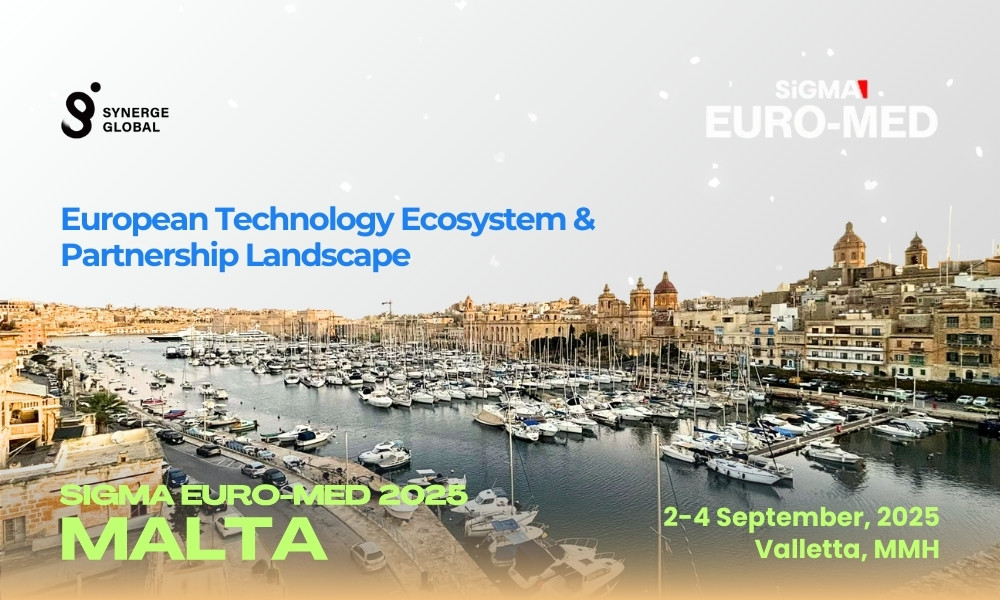
In the second half of 2025, Synerge Global attended SiGMA Euro-Med 2025 in Malta from 1–3 September. Following ICE Barcelona 2025 earlier in the year, this event marked another key milestone in the company’s international agenda. This time, the focus was to observe Europe’s gaming and online entertainment industry from a perspective closer to collaboration and project execution—understanding how technology ecosystems are evolving and how cross-border operations are being implemented in practice.
SiGMA Euro-Med 2025 was held at the Mediterranean Maritime Hub (MMH) in Malta, bringing together operators, technology providers, and industry partners from across Europe and beyond. The event spotlighted topics such as technological innovation, regulatory trends, and evolving partnership models. For Synerge Global, SiGMA was not only an opportunity to track the pulse of the European market, but also a crucial venue to validate whether its existing product and service roadmap aligns with the practical needs of operators and partners in the region.
At the system and project execution level, Synerge Global paid particular attention to how different platforms and technology providers approach the “actual implementation” phase. Many solutions on the show floor went beyond feature demos to include details on integration approaches, the quality of technical documentation, availability of testing environments, and version management processes. These elements, while often treated as secondary details, in reality determine whether a project can go live within agreed timelines and resource constraints, and how easily it can be adjusted or expanded in the future. They also provide important input for Synerge Global as it continues to refine its own API design and implementation support practices.
From a governance and compliance perspective, multiple conference sessions focused on regulatory updates and technical standards across Mediterranean and European jurisdictions, underscoring that requirements are no longer just legal texts, but starting points for product planning and system design. The structure of behavioral and operational logs, how audit trails are stored, and how different regulators expect reports and data to be presented are all being considered at the architecture level, rather than added as patches after development. This aligns with Synerge Global’s principle of treating “compliance and architecture as concurrent considerations” instead of sequential steps.
In terms of cross-border market entry and multi-market operations, discussions at SiGMA further reinforced that the core challenge is not only whether a new market can be activated, but whether a single core architecture can be maintained and extended over time. Building separate systems for each region may offer flexibility in the short term, but it quickly leads to maintenance complexity and a growing technical burden. As a result, the industry is increasingly focused on how configuration files, rules engines, and modular combinations can be used to support multiple markets within a single system, while still leaving room to adapt to future regulatory or technical standards.
These insights and observations have now been incorporated into Synerge Global’s system architecture planning and consulting methodology. The goal is to help enterprises expanding into Europe and other regions balance technical stability with cross-border operational requirements—using one coherent, maintainable core platform to support long-term, multi-market growth instead of a fragmented set of regional systems.
Disclaimer: The information provided herein reflects general industry knowledge and does not constitute legal or regulatory advice.