Starting from ICE Barcelona 2025: Synerge Global’s Perspective on Technology and Cross-Border Operations in the Gaming Industry
Focusing on platform and backend system design, compliance-by-design, and multi-market operations, drawing on insights from ICE Barcelona 2025, to support cross-border market entry.
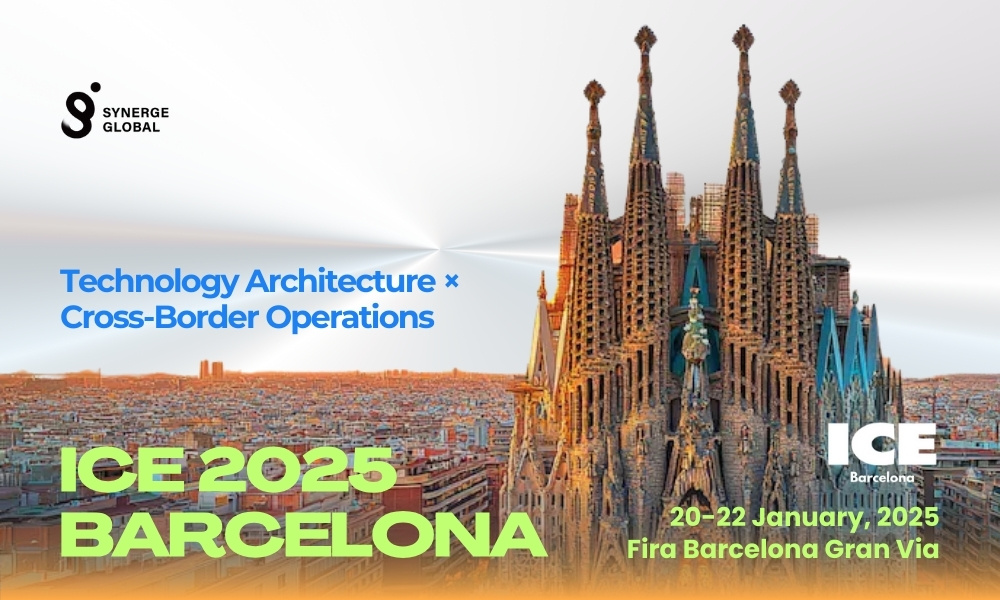
Synerge Global, a company specializing in software development, technology consulting, and cross-border market enablement, regards ICE Barcelona 2025 as a key starting point in its international calendar this year. Attending as observers rather than exhibitors, the team walked the show floor, joined conference sessions, and engaged in in-depth conversations with platform providers and technology vendors. The goal was to understand the latest approaches to system architecture, development models, compliance design, and cross-border operations, and to clarify what enterprises truly need to prioritize when planning their technology roadmap and market expansion over the next few years.
Held in Barcelona, Spain, ICE Barcelona 2025 is one of the world’s flagship B2B gaming exhibitions, bringing together operators, technology suppliers, and regulators from across the globe. The event centers on innovation, regulatory developments, and market growth. For Synerge Global, three tightly connected themes stood out this year: platform and backend architectures built around modularity and APIs; compliance and player protection being embedded directly into system design; and the question of how a single core platform can effectively support cross-border market entry and multi-jurisdiction operations.
At the platform and system level, most solutions are moving towards being “decomposable and easy to integrate.” From game engine management and rules or risk configuration to reporting and back-office tools, more providers are adopting modular services with clearly defined API interfaces, allowing different functions to connect via standardized methods. This architecture enables operators to introduce new products or tools without tearing down existing platforms, while maintaining consistency in versioning and operational processes. It also leaves room for future enhancements in monitoring, analytics, and observability.
On the compliance and player protection front, many requirements that were once treated as “operational procedures” or “documentation tasks” are now being written directly into system architecture. License management, transaction and behavioral monitoring, risk detection, and restriction mechanisms are no longer just add-on modules; they are being designed from the level of data structures and event logging. How to retain critical audit trails, how to match the reporting formats of different regulators, and how to quickly reconstruct and explain key events are all treated as core platform capabilities. “Compliance as design” is rapidly becoming a new norm for software teams, and one that companies can no longer ignore.
In terms of cross-border market entry and multi-market operations, conversations at ICE highlighted the significant differences between jurisdictions in terms of regulatory frameworks, technical standards, and user behavior. For companies looking to expand across multiple regions, the key question is no longer just “can we go live in a given country,” but rather how to use a single core platform and codebase to support many markets through configuration files, rules engines, and modular combinations. Doing so reduces the need to maintain separate, heavily customized branches for each jurisdiction and helps prevent the steady accumulation of technical debt and operational risk.
Synerge Global is transforming its firsthand observations from ICE Barcelona 2025 into practical guidance for system architecture planning, product development processes, compliance implementation, and international operations consulting. The aim is to help enterprises design and build gaming-related systems with a “global-ready” technology foundation and cross-border operational mindset from day one, instead of being forced to retrofit and remediate only after entering new markets.
Disclaimer: The information provided herein reflects general industry knowledge and does not constitute legal or regulatory advice.