What Has Really Changed in Game Development After AI?
Breaking down the concrete benefits and limitations of AI across planning, development, and testing within real-world project workflows.
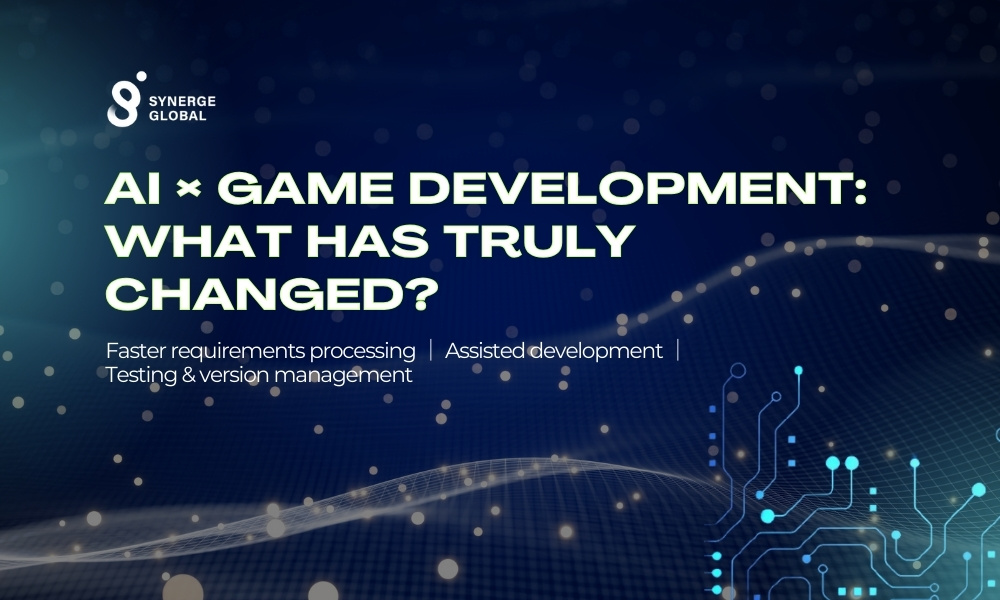
Over the past one to two years, AI has become a keyword on almost every development team’s agenda. For B2B teams focused on game software development, however, the real question is not “Can AI build a game?” but rather: within an existing project workflow, which parts of the process have genuinely changed because of AI—and how?
In the early stages of a project, AI’s most visible impact lies in accelerating information processing and producing initial drafts. When teams face client requirements, competitive analysis, or discussions around gameplay direction, AI can first generate consolidated summaries to help structure key points, break down needs, and propose possible flows or feature combinations. Final decisions still rest with product and planning roles, but the “blank page” phase becomes significantly shorter, and alignment with clients can be reached more quickly.
During the development phase, AI typically acts as an assistant engineer rather than a replacement. In practice, AI can help generate boilerplate code, provide invocation examples based on existing specifications, fill gaps in test coverage for existing modules, or suggest refactoring options and debugging directions. For B2B teams, the value lies in offloading repetitive, well-structured tasks to tools, so engineers can focus their time on architecture design, module boundaries, and performance optimization—the decisions that truly determine the long-term quality of the platform. Content-related work has also adopted a different rhythm: interface copy, in-game prompts, and other elements that require multiple variations can first be generated by AI, then filtered and refined by product and design before being brought to client discussions. For B2B developers serving multiple brands and markets, this approach helps align tone and style early, reducing the risk of major rework in later stages.
In the testing and delivery phase, AI is more often used to support coverage and organization than to replace the testing process itself. From summarizing error logs and clustering recurring issues, to generating regression test scripts and simulating specific interaction paths, AI can reduce manual workload and free testers to concentrate on scenario design and result interpretation. When projects must support multiple regional versions or different client configurations, AI can also help compare settings and multi-language content, making it easier to ensure version consistency and reducing the chance of missed discrepancies.
At the same time, AI introduces new questions about boundaries: which outputs can flow directly into codebases or design files, and which should serve only as references requiring human review and adjustment? Without clear rules, AI quickly becomes a tool that each team member “uses in their own way,” instead of being integrated into a shared workflow. For B2B providers, defining where AI is allowed to intervene in a project and how its outputs will be validated is more important than simply encouraging everyone to “use AI more.”
From Synerge Global’s perspective, what AI has changed in game development is not the existence or disappearance of a single role, but the division of work and pace across the entire production line. Requirements can be organized faster, repetitive work in development and testing can be reduced, and teams gain more space to focus on judgment and design itself. For B2B game development teams that aim to serve multiple clients and markets over the long term, the key challenge in the coming years will be how to deliberately position AI within their processes—so that it becomes a stable part of production capacity, rather than a short-lived experiment.
Disclaimer: The information provided herein reflects general industry knowledge and does not constitute legal or regulatory advice.